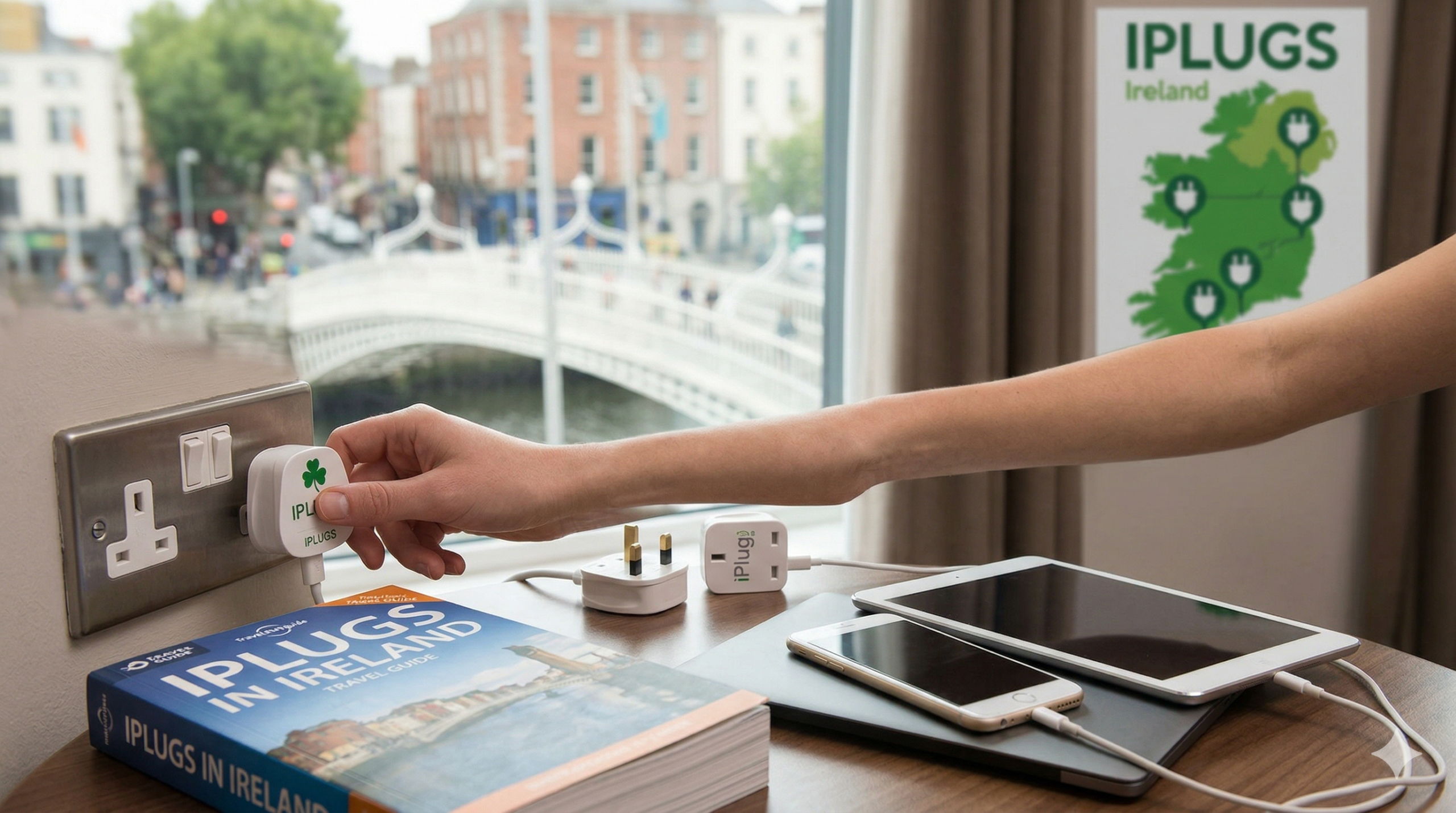
Whether you’re touching down at Dublin Airport for a “coolcation” or setting up your digital nomad workstation in a cozy Galway café, there is one thing that can ground your trip to a halt: a dead battery and the wrong plug. In 2026, as Ireland becomes a top destination for tech-focused travelers and remote workers, staying “charged up” is about more than just a cable—it’s about knowing the local grid. Here is everything you need to know about power in the Emerald Isle.
1. The Anatomy of an Irish Socket: Type G
Ireland uses the Type G plug. If you’ve traveled to the UK, you’ll recognize it immediately. It features three sturdy, rectangular pins arranged in a triangular pattern.
-
The Safety Feature: Unlike many other global plugs, Type G sockets in Ireland almost always have an individual on/off switch. If your charger isn’t working, check the switch on the wall first!
-
The “Shutter” System: Irish sockets have a safety shutter. The top (ground) pin is slightly longer and “opens” the bottom two holes. This is why you should never try to force a two-pin plug into an Irish socket without an adapter.
2. Voltage & Frequency: The “230V” Rule
Ireland operates on a 230V supply voltage and a frequency of 50Hz.
-
For Smartphone & Laptop Users: Most modern electronics (iPhones, MacBooks, Samsung Galaxy devices) are dual-voltage (100V-240V). You likely only need a physical plug adapter, not a bulky voltage converter.
-
The “Hairdryer Hazard”: If you are visiting from the US, Canada, or Japan (110V-120V regions), be extremely careful with high-heat appliances like straighteners or hair dryers. Unless they specifically say “Dual Voltage,” plugging them into an Irish 230V outlet can cause them to overheat or fry instantly.
3. 2026 Travel Trends: The Rise of USB-C Wall Ports
As we move further into 2026, many Irish hotels, renovated Airbnbs, and even “Bus Éireann” coaches have integrated USB-C charging ports directly into the walls or seats.
Pro Tip: While these are convenient for a quick top-up, they often charge slower than a dedicated wall brick. For “Power Users” or digital nomads, always carry your primary Type G wall block for the fastest charging speeds.
4. Where to Buy Adapters in Ireland
Forgot your adapter? Don’t panic. You can find them almost anywhere, but prices vary:
-
Penneys (Primark): Usually the cheapest place to grab a reliable “Universal to Ireland” adapter.
-
Boots / Pharmacies: Found on almost every high street and in airports.
-
Tesco / Dunnes Stores: Check the “Electrical” or “Travel” aisle.
-
Avoid: Buying them inside the airport terminal if possible, as they are often marked up by 200%.
5. Quick “Charging Checklist” for Ireland:
-
Check the Label: Look for “Input: 100-240V” on your device.
-
Pack a Multi-Plug: Since Irish hotel rooms sometimes have limited outlets, a small travel power strip with one Type G plug can charge all your devices at once.
-
Bathroom Sockets: In Ireland, bathroom sockets are usually only for low-wattage shavers (often 2-pin 115V/230V). Do not try to plug your phone or laptop into the bathroom shaver socket!
