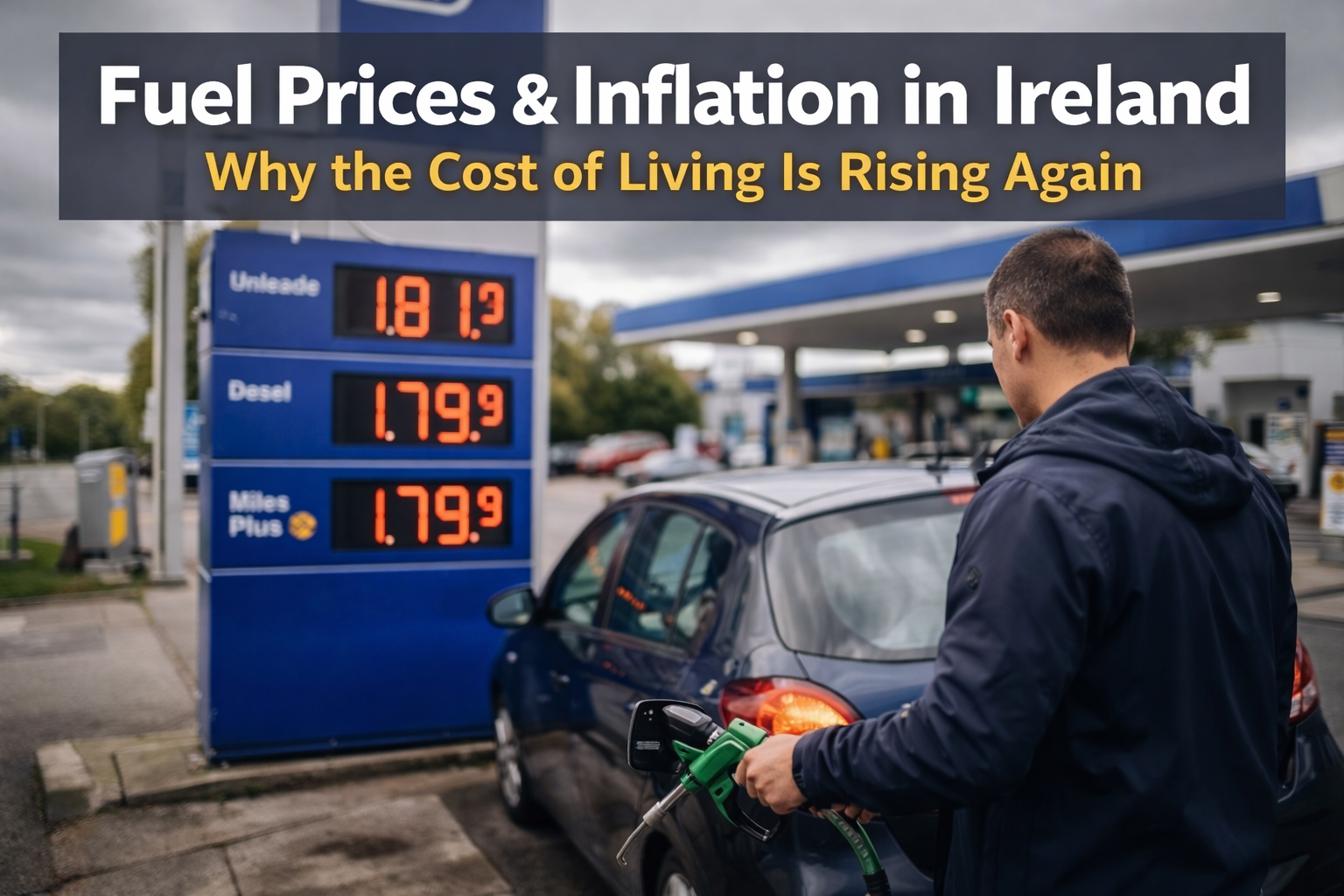
Fuel Prices and Inflation in Ireland: Why the Cost of Living Is Rising Again in 2026
For many households in Ireland, the cost-of-living conversation never really went away — it just changed shape.
After a period of relative stabilisation, fuel prices, energy costs and inflation are back in focus in 2026, putting fresh pressure on family budgets, commuters, small businesses and rural households. While Ireland is not seeing the same extreme inflation rates as 2022–2023, the financial squeeze is still very real — especially when fuel, food, housing and insurance costs all continue to stack up together.
If you’ve noticed that it feels harder to stay ahead financially, you’re not imagining it.
Inflation in Ireland is still affecting everyday life
According to the Central Statistics Office (CSO), consumer prices in Ireland were 2.7% higher in February 2026 than they were a year earlier. That means inflation is lower than the crisis peaks of recent years — but prices are still rising, not falling. The same CSO release also showed that prices rose 0.9% in a single month between January and February 2026.
That matters because even “moderate” inflation can still feel severe when it lands on top of:
- high rent or mortgage costs,
- childcare bills,
- insurance increases,
- grocery spending,
- and transport costs.
Inflation is not just an economic statistic. It’s the gap between what your income used to cover and what it covers now.
Why fuel prices are suddenly such a big issue again
One of the biggest triggers behind Ireland’s current cost pressure is fuel and energy volatility.
Recent international tensions have pushed oil markets higher, and Irish motorists have already felt the impact. Irish reporting in March noted that fuel prices moved above €2 per litre in some parts of the country, with concerns that households could face hundreds of euro in extra annual transport and energy costs if the spike continues.
That’s especially significant in Ireland because fuel is not a luxury cost for many people — it is a daily necessity.
For large parts of the country, especially outside major cities, people rely on:
- private cars for commuting,
- home heating oil,
- longer travel distances for work and school,
- and transport-heavy household routines.
So when fuel rises, it doesn’t just hit the petrol station. It spreads through everyday life.
